Huaca Pucllana changes the scale of Lima without requiring the city to disappear. The earthen platforms rise inside modern Miraflores, among apartment buildings, traffic, restaurants and the ordinary movement of a wealthy coastal district. This is not archaeology beyond Lima. It is archaeology inside Lima.
The traveller reached Pucllana on 11 September 2026, after Barranco and the Miraflores coast. Around an hour gave the site enough room to make its point: the city had not been replaced by a ruin, and the ruin had not been pushed outside the city. Both were present at once.
That is why Huaca Pucllana deserves a place in a Lima itinerary. The Historic Centre supplies the colonial city. Barranco and Miraflores supply neighbourhoods, cliffs and the Pacific. Pucllana adds the much older city beneath them, in a form that can be read through the material in front of the traveller rather than through a distant museum label.
For the wider route, continue to the three-day Lima itinerary or the best things to do in Lima guide.
I. An older city inside Miraflores
Pucllana is not a mound encountered after the city has thinned out. It sits in Miraflores, where the road network, apartment blocks and commercial streets continue almost up to the archaeological boundary. The first impression is therefore spatial. Modern Lima does not frame the huaca from a respectful distance; it presses against it.
That collision gives the visit its shape. The site’s earth-coloured platforms belong to a coastal society that built here many centuries before the Spanish foundation of Lima, while the district around them belongs to the city’s present tense. The older architecture has not been placed in a remote landscape for contemplation. It survives inside the neighbourhood that grew around it.
The effect is more precise than the usual language of ruins suggests. There is no need to imagine a lost world floating free of the city. The streets remain audible beyond the walls, and the surrounding buildings keep their place in the view. Pucllana matters because the archaeological past is still part of the urban argument.
II. The Lima culture and the adobe pyramid
Huaca Pucllana was built by the Lima culture, a society of Peru’s central coast active between roughly 200 and 700 AD. The monumental complex took its principal form between about 450 and 650 AD, when it functioned as a ceremonial centre with administrative importance. Public religious activity, gatherings and the organisation of work belonged to the same architecture.
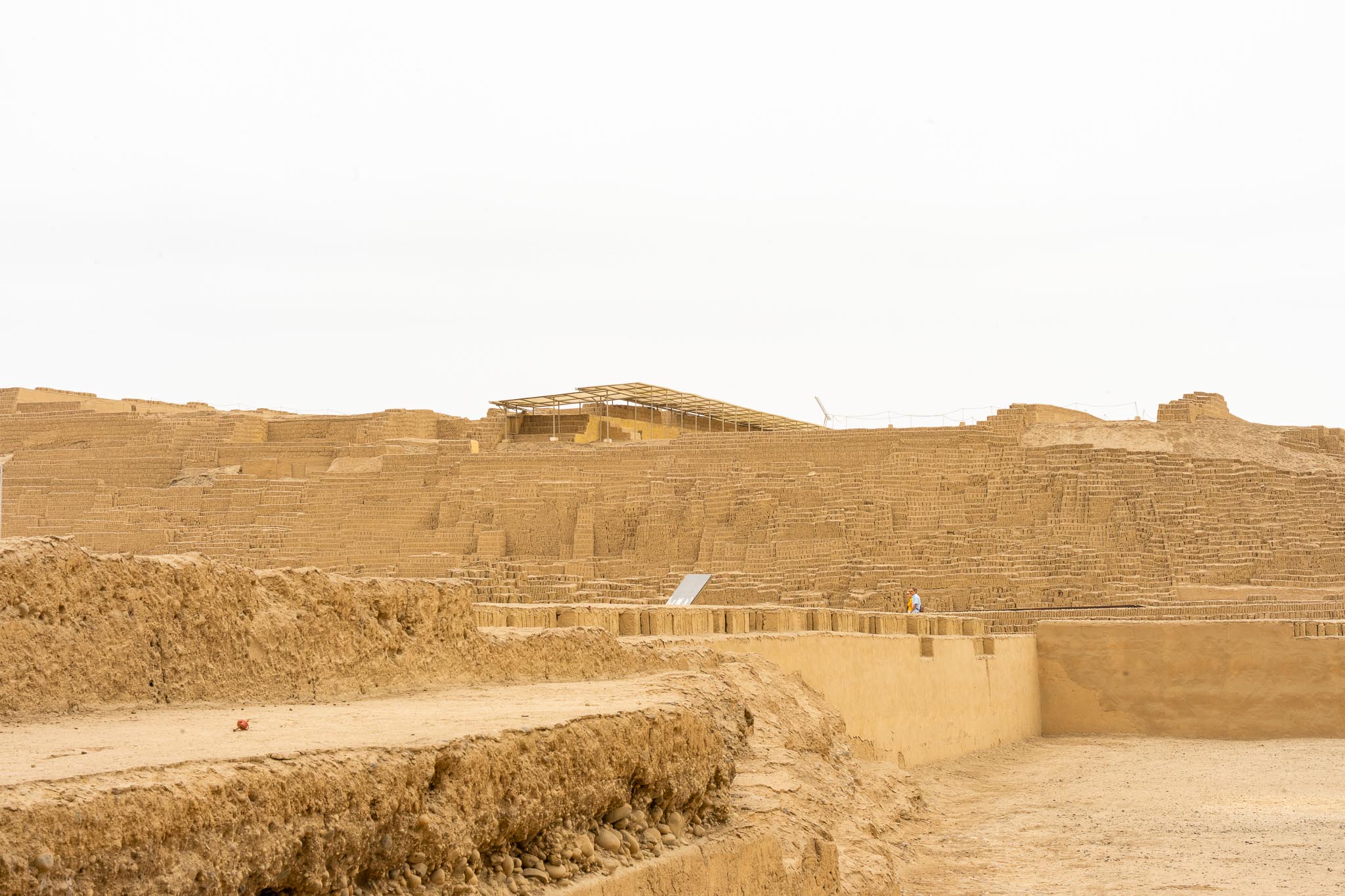
The building material is the first thing worth studying. The Lima people made small adobe bricks by hand and placed them vertically in rows, a method often compared to books standing on a shelf. Repeated across walls and platforms, the technique gave the complex its particular surface: not a single poured mass of earth, but an immense field of individual units held together by labour.
Those bricks were not simply stacked to make one pyramid. The complex included rooms, patios, corridors, ramps and staircases. Its great pyramid rose through stepped platforms, while other sectors were less monumental and more closely connected to the movement of people through the ceremonial centre. Walls and spaces were remodelled over time; older architecture could be filled with stones, sand and earth before a new structure was raised above it.
That process gives the site a different kind of depth. The ground is not only what remains after a building has fallen. It contains earlier versions of the building, closed and buried as part of later construction. In Lima’s dry coastal environment, adobe could survive long enough for one phase of architecture to become the foundation of another.
The site’s history did not end with the Lima culture. After Pucllana was abandoned as a Lima ceremonial centre, Wari groups used the upper part of the pyramid as a burial place for members of their elite. Later, Ychsma communities in the Rímac and Lurín valleys also buried people and placed offerings at the site. The pyramid therefore holds more than one cultural phase, not as a neat sequence of replacements but as successive uses of a place that retained significance.
III. What the site reveals
The traveller sees the great earthen platforms first: long walls, raised terraces and the geometry of a complex that was designed to control movement and attention. The scale is large enough to change the surrounding district, but the surface remains close and physical. These are walls made from thousands of small pieces, not a smooth stone monument whose construction disappears into abstraction.
The site museum extends that reading. Pucllana has operated as a research, conservation and education project since the early 1980s, and the site museum opened in 1984. Its collection comes from excavations at the complex and includes ceramics, textiles, objects in wood and stone, and material connected to the lives and rituals of the societies that used the site. The archaeological circuit and exhibition space belong together: one shows the architecture at scale, the other gives the fragments a chronology and a human context.
The Lima culture’s relationship with the sea also enters through the objects and imagery associated with the site. Marine animals and waves appear in the visual language of ceramics and textiles, a reminder that this was a coastal society whose world was shaped by the Pacific even when its ceremonial architecture stood inland. The ocean does not need to be visible from every platform for it to remain part of the site’s meaning.
The later burials add another layer. Pucllana was not a single-use monument that became irrelevant when its first builders left. Wari and Ychsma activity placed new bodies, offerings and interpretations into the old architecture. The great pyramid is therefore less a frozen statement than a record of continued attention.
IV. Why Pucllana changes the way Lima reads
The strongest moment of a Pucllana visit comes when the modern district returns to the edge of the frame. A road, a high-rise or a line of trees makes the contrast unavoidable. The huaca is not an excursion from Lima’s contemporary life; it is one of the places where that life becomes easier to understand.
This is the difference between seeing archaeology as a destination and seeing it as a layer. At Pucllana, the traveller does not leave the modern city in order to find the old one. The two are held together by the same horizon, and the tension between them is the experience.
That makes the site a natural companion to the rest of a Lima stay. Barranco and Miraflores show the city through streets, public space and the coastal edge. Pucllana turns the same district inward. The Barranco to Miraflores route is about moving through contemporary neighbourhoods; this visit explains how much older the ground beneath those neighbourhoods is.
How much time do you need?
Allow around one to one and a half hours for a focused visit. The traveller spent roughly an hour at Pucllana, which worked well as part of a longer archaeological day. A slower visit, a full guided circuit or more time in the exhibition space can justify staying longer.
Pucllana works particularly well after Barranco or the Miraflores coast, when the day has already established Lima’s modern neighbourhoods. The shift into adobe architecture then feels deliberate rather than isolated. Huaca Huallamarca and Museo Larco can extend the same archaeological thread afterwards, although neither is necessary to make Pucllana worthwhile on its own.
Is Huaca Pucllana worth visiting?
Yes. Pucllana is one of Lima’s strongest experiences because it makes the city’s archaeological depth visible inside modern Miraflores. The platforms are visually distinctive, the visit is manageable within a wider day, and the site adds pre-Hispanic Lima to an itinerary that might otherwise be dominated by the colonial centre, museums and the Pacific coast.
The qualification is practical rather than dramatic. With only a few hours in Lima, the Historic Centre or a combined Barranco-and-Miraflores day may take priority according to the traveller’s interests. With two or three days, Pucllana earns its place because it changes how the rest of the city reads. Lima existed long before the Spanish foundation, and here that fact is not an abstract historical sentence. It is built into the neighbourhood.
Huallamarca and Museo Larco
Huaca Huallamarca, in nearby San Isidro, is useful as a second pre-Hispanic mound within modern Lima. It confirms that Pucllana is not an isolated survivor, but part of a wider archaeological landscape that the contemporary city has grown around. The two sites should not be collapsed into one experience: Pucllana is the larger architectural argument, while Huallamarca gives the day another scale and setting.
Museo Larco provides a different continuation. Pucllana gives the traveller architecture, construction and the changing use of one ceremonial centre. Larco supplies a broader chronology through objects, ceramics, textiles and other material from across ancient Peru. One makes the city’s earlier layer visible in place; the other helps place that layer within a longer history.
Huaca Pucllana matters because modern Lima never quite manages to bury the city that came before it. The adobe platforms remain in Miraflores while roads, apartments and restaurants continue around them, making the archaeological past part of the neighbourhood rather than an excursion beyond it. That is enough to justify the stop.
But the road is ever onward.