Huayna Picchu changes the direction of the Machu Picchu story. The familiar view looks towards the mountain; this route climbs into it. The traveller leaves Aguas Calientes early, exchanges the archaeological park’s terraces for steep stone stairs and vegetation, and gradually turns the famous postcard into a landscape with the ruins below.
This is not another viewpoint in the ordinary sense. A viewpoint asks the mountain to perform. Huayna Picchu makes the traveller enter the mountain’s structure: narrow trail, irregular steps, high ridges and openings over the valley. The climb gives Machu Picchu a different scale because the citadel is no longer the whole scene. It becomes one part of the country seen from above.
The climb took place on 14 September 2026, between the rail-town arrival and the following morning’s archaeological-park visit. The day began before dawn and the Huayna Picchu visit occupied roughly three and a half hours before the route returned to Aguas Calientes. For the wider sequence, see the Machu Picchu and Aguas Calientes itinerary. This page stays with the mountain.
I. Into the Mountain
The morning began at 5:30am, with Puente Ruinas reached around 5:55–6:00am and the Huayna Picchu block beginning shortly afterwards. Those details matter less as a timetable than as a shape: Huayna Picchu is an early climb, and the mountain occupies the active centre of the day before the traveller descends to town level.
The route leaves the famous composition behind almost immediately. Machu Picchu is usually encountered as a citadel arranged across a ridge, its terraces and stonework held in a single view. Huayna Picchu reverses that relationship. The ruins become something below and behind the movement, while the path turns towards rock, vegetation and the steep country around the Urubamba valley.
There is a particular difference between walking towards a mountain and walking into one. The first is an approach. The second is a negotiation with slope, stone and space. Huayna Picchu belongs to the second category.
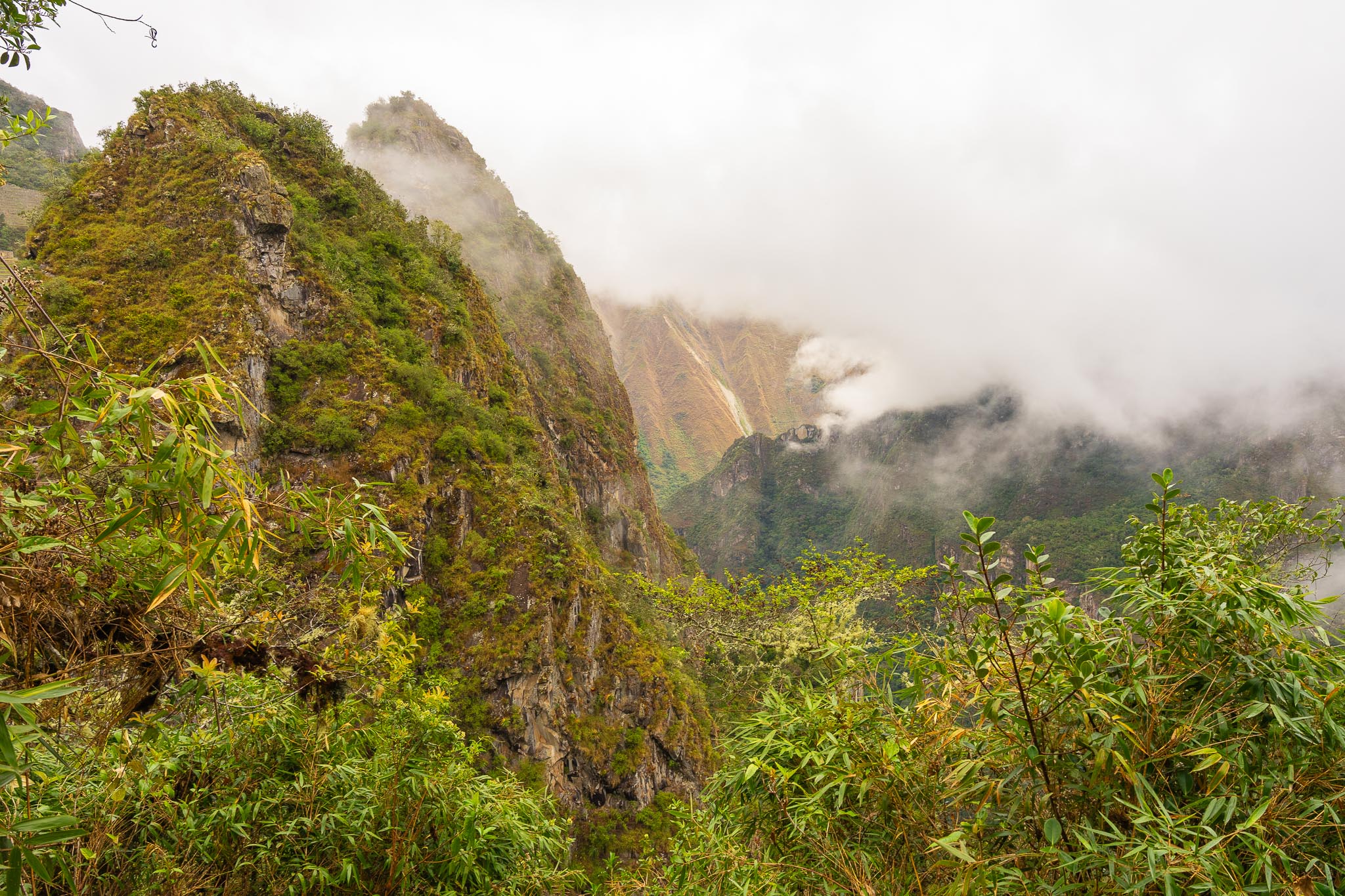
II. Stairs, Stone and Height
The physical character of the climb is clear. Stone stairs rise through vegetation, with irregular surfaces that belong to a mountain route rather than a modern staircase. In narrower sections the path occupies a thin line between masonry, plants and open-looking views. Expect a serious mountain climb rather than a simple walk to a viewpoint; the shape of the trail matters more than any simple label.
Huayna Picchu is demanding because it combines slope, stairs and height. The climb is not a flat walk ending at a scenic platform. It asks the traveller to keep ascending through changing terrain, with the mountain opening and closing around the path. Conditions can alter the experience, especially where stone and narrow sections meet weather, so current access and conditions deserve attention before departure.
The Inca presence is part of what gives the route its character. Stonework is not a decorative surface added to a natural hike; the path belongs to a mountain landscape that was shaped, occupied and connected to the wider Machu Picchu site. The route’s difficulty and its historical meaning therefore meet in the same material: steps cut into steep country, vegetation growing around old masonry, and a trail that makes the ridge itself part of the archaeological experience.
This is why the route feels different from looking across at Huayna Picchu from the citadel. From below, the mountain completes the image. On the climb, its slopes determine every next section of the visit.
III. The View Changes
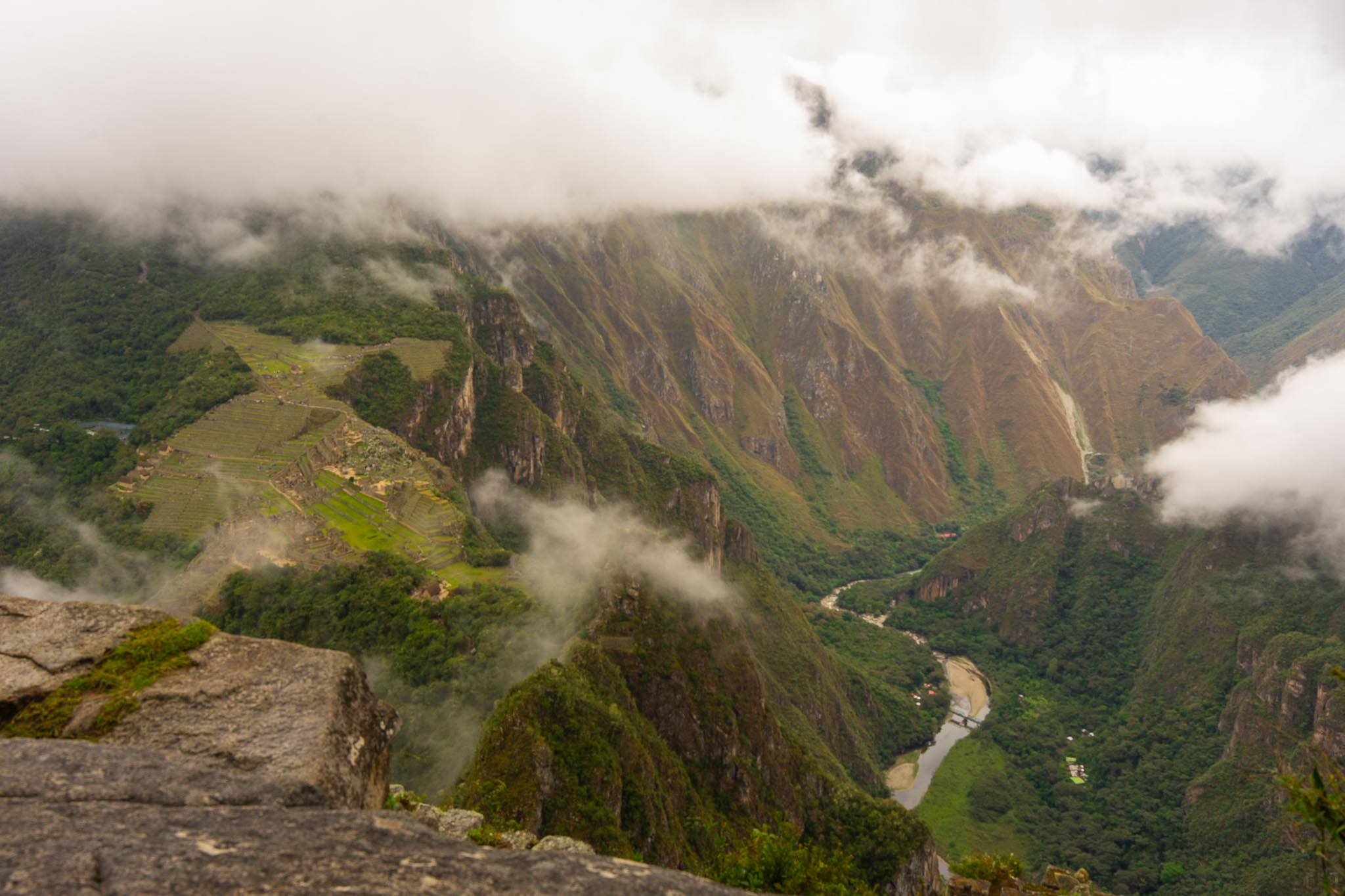
The views widen as the trail rises. Close vegetation gives way to green ridges, cloud and the valley system below. The landscape no longer sits behind the ruins as a dramatic background. It surrounds the route, with the traveller looking across folds of mountain and down into the country that contains both the railway town and the archaeological park.
Cloud belongs to these upper views. It passes across ridges and leaves parts of the valley open while closing others. That is not a separate weather story; it is part of the way the mountain is seen. Huayna Picchu changes the visit by making distance unstable. A wall of cloud can shorten the view, then an opening can reveal how far the valley extends.
The broad perspective also makes Machu Picchu more legible. The citadel is no longer an isolated arrangement of terraces. It sits inside a larger geography of ridges, river, forest and steep slopes. The mountain gives the ruins their drama, but the climb shows that the ruins depend on the mountain’s scale to be understood.
IV. The High Point and the Return
Higher on the route, the trail reaches its strongest viewpoints over the surrounding landscape. The important change is not a single summit scene but the accumulated shift in position: the traveller has moved from the town below the ruins, through the archaeological setting, and into a mountain vantage where the valley carries the eye beyond Machu Picchu.
The Huayna Picchu visit ended around 9:47am, leaving the rest of the day at Aguas Calientes. The Butterfly Zoo, market and hot springs followed at town level. They are not extensions of the hike; they are the descent into the human scale that the mountain temporarily suspends.
That return matters. Huayna Picchu is not a self-contained mountain excursion detached from Machu Picchu. It is the physical centre of a day that begins in the rail town, rises into the mountain and ends among the streets, market and springs below. The Aguas Calientes beyond Machu Picchu guide follows that lower-town side of the stay.
How hard is Huayna Picchu?
Huayna Picchu is physically demanding because of its steep stone stairs, narrow sections and sustained climb. It is better understood as a serious mountain route than as a gentle walk to a viewpoint, though it is not technical mountaineering.
Fitness matters, and so does comfort with height and narrow terrain. A fit walker should still expect a substantial climb. Anyone uneasy with steep drops or exposed-looking sections should study current route information before booking. Weather and trail conditions can change the character of stone stairs, so the official access guidance should take precedence over any historical account.
The useful preparation is practical: allow the mountain morning to remain the physical centre of the day, wear footwear suited to uneven stone, and do not build a second demanding excursion immediately afterwards. Stairs, slope, vegetation and height are the defining facts.
Is Huayna Picchu worth doing?
Yes, if the traveller wants Machu Picchu to become physical rather than purely observational. The climb changes the relationship between the three elements of the visit: the ruins are no longer only the object being viewed, the mountain is no longer only the backdrop, and the path becomes part of the history and geography holding them together.
The limited access makes the mountain a distinct part of the visit, but the reason to prioritise it is not scarcity alone. Huayna Picchu offers a different way to understand the site. From the citadel, the mountain completes the composition. From the trail, the citadel becomes one structure inside a much larger landscape.
Practical planning
Book Huayna Picchu first
Book through the official Machu Picchu ticket portal and check the current Huayna Picchu ticket, circuit and entry-window rules before fixing the rest of the itinerary.
Start early
The climb began before dawn, with the route moving from Aguas Calientes towards Puente Ruinas before the Huayna Picchu block. An early start protects the mountain portion of the day and leaves room for the return to town. Build the later Butterfly Zoo, market and hot springs around the climb rather than trying to make the mountain fit around them.
Expect steep stairs
Prepare for irregular stone stairs, narrow trail sections, vegetation and high views. The climb is steep rather than technical, but height and route width may matter as much as fitness. Check current closures, conditions and access rules before departure.
Leave the rest of the day lighter
The climb occupied roughly three and a half hours. The same day continued at Aguas Calientes, but the town activities were a useful lower-level continuation rather than another mountain programme. The two-day Machu Picchu itinerary places the climb inside the full rail-town and archaeological-park sequence.
From the mountain back to the town
Huayna Picchu is the moment when Machu Picchu stops being only a famous view. The traveller leaves the railway town, climbs through stone and vegetation, and reaches a position where ridges, cloud and the Urubamba valley surround the ruins instead of framing them.
From below, Huayna Picchu is part of the iconic image. From the trail, Machu Picchu becomes part of the landscape below. That reversal is the climb’s lasting argument: the mountain is not scenery attached to the archaeological park, and the ruins are not an isolated object placed in a valley. They belong to one steep, connected geography.
The wider journey continues in the 24 Days in South America itinerary.
But the road is ever onward.