Buenos Aires begins with a square. Around Plaza de Mayo stand the presidency, the Cathedral, the old Cabildo and the Pirámide de Mayo, each carrying a different layer of the city’s political history. Few places compress so much national memory into such a small piece of urban ground.
That made it a fitting beginning after the traveller arrived from Iguazú, left the bags in Palermo and turned towards the centre. The afternoon moved through the Cathedral, the Casa Rosada area, Manzana de las Luces, Plaza de Mayo and the streets leading towards Congress before dinner at Parrilla Peña. It was not the whole city. It was the civic key that allowed the later neighbourhoods to make sense.
The square matters because the open space itself is part of Argentine history. Government, Catholic authority, colonial administration, the May Revolution, presidential power and the country’s recurring tradition of public assembly all meet here. Plaza de Mayo is not a monument placed among other monuments. It is the stage on which the city has repeatedly argued with itself.
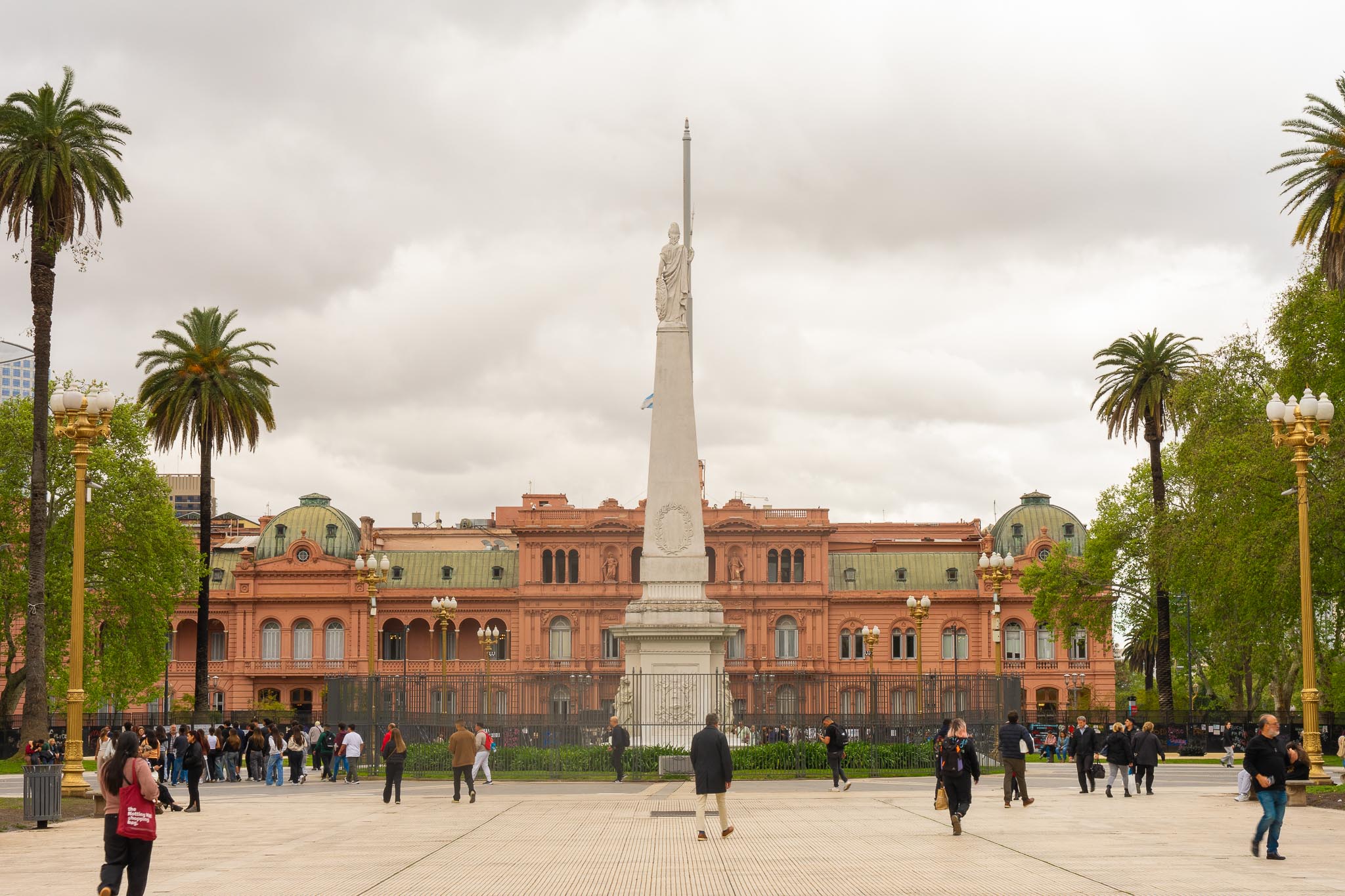
The Square at the Centre of Argentine History
The square began as the Plaza Mayor of the colonial city, the open ground from which government, religion and commerce were organised. It was later known as Plaza de la Victoria before taking the name Plaza de Mayo after the events of 1810. The changes in name matter because they show the square moving from colonial possession towards national memory.
In May 1810, a cabildo abierto and the pressure of public opinion helped bring about the first autonomous government in Buenos Aires. The process did not complete Argentine independence overnight, but it made this square the setting for the political break that followed. The May Revolution gave the plaza its modern name and its permanent place in the national imagination.
The Pirámide de Mayo stands at the centre. Built in 1811 to mark the first anniversary of the Revolution, it was later remodelled, with the original structure retained inside the present monument. The figure of Liberty at its summit is small against the surrounding buildings. That is part of its effect. It is a marker within a much larger field of political memory.
The square has never been frozen as heritage. Presidential inaugurations, speeches and demonstrations have continued to return public life to the same open space. The Mothers of Plaza de Mayo began gathering around the pyramid in 1977 to demand information about children who had disappeared during the military dictatorship. The painted white headscarves around the monument keep that later history visible beneath the older national story.
Casa Rosada and Political Buenos Aires
Casa Rosada occupies the site of the old Buenos Aires fort and the former customs area beside the river. The building that faces the square was formed by joining earlier government and post-office structures, creating the long pink façade that now stands as the most recognisable image of executive power in Argentina.
The colour is associated with President Domingo Faustino Sarmiento, whose government had the building painted pink in the nineteenth century. The explanation is often reduced to a story about mixing the colours of rival political factions, but the more useful fact is architectural: Casa Rosada became a symbol by facing the plaza directly. Its balconies turn the open ground into a place from which national power can address the public.
The balcony has carried that symbolism through presidential speeches and political gatherings, while the building itself remains the seat of the national executive. The traveller’s visit was exterior and square-based, which is enough to understand the relationship between façade, balcony and public space. The Museo Casa Rosada occupies the wider complex and its access, exhibitions and opening arrangements should be checked through the official government information before travel.
Casa Rosada is therefore more than a pink building to photograph. It is the modern republic placed at the edge of a colonial square, with the old fort beneath it and the public still gathering in front of it.
The Metropolitan Cathedral and the Cabildo
The Metropolitan Cathedral gives the square its religious authority. The building in front of Plaza de Mayo is the sixth church raised on the site since the city’s second foundation. Its present form took shape over a long period, beginning in the eighteenth century and receiving its completed decoration much later. The neoclassical front does not compete with Casa Rosada so much as hold the other side of the square in a different kind of power.
Inside, the Cathedral contains the mausoleum of General José de San Martín, whose campaigns helped secure independence for Argentina, Chile and Peru. It was also the church of Jorge Mario Bergoglio during his years as Archbishop of Buenos Aires before he became Pope Francis. Those connections place the Cathedral within both the national story and the city’s living Catholic identity, whether or not a particular visit includes the interior.
Opposite it, the Cabildo pulls the square back towards the colonial city. It was the seat of municipal government under Spanish rule and the building associated with the open council of May 1810. The present structure is smaller than the original because later changes to the city removed parts of it, but enough remains to show what the civic square looked like before the modern government palace took its current form.
Casa Rosada belongs to the modern executive state. The Cabildo belongs to the colonial municipality that helped produce the May Revolution. The Cathedral stands between those histories as religious authority. Plaza de Mayo becomes legible when the three are read together rather than photographed as separate stops.
Manzana de las Luces and the Older City
A few blocks south, Manzana de las Luces moves the historic centre away from national symbolism and into the intellectual and religious institutions of colonial Buenos Aires. Jesuits built the Church of San Ignacio and the surrounding complex; after their expulsion, the buildings continued through different educational, religious and civic uses. The block later held a college, an early university, a printing press, a museum and a library.
That history explains the name. Manzana de las Luces — the Block of Enlightenment or Lights — referred to the concentration of cultural institutions that once occupied the block. It is one of the places where the city’s older life survives not as a single façade but as a dense accumulation of uses.
The complex is also associated with colonial tunnels beneath the surrounding buildings. Their availability and the form of any guided visit can change, so they belong in the planning conversation rather than as a guaranteed part of every visit. The block is worthwhile even without turning the day into an underground excursion: San Ignacio and the surviving buildings draw the square’s political history back into the older city that preceded the republic.
Avenida de Mayo to Congress
Plaza de Mayo works especially well because it does not have to be visited in isolation. Avenida de Mayo extends the civic reading west towards Plaza del Congreso, joining the executive square to the seat of the national legislature in a long urban axis. Opened in 1894, the avenue carries the city from the colonial centre into the monumental ambitions of the late nineteenth and early twentieth centuries.
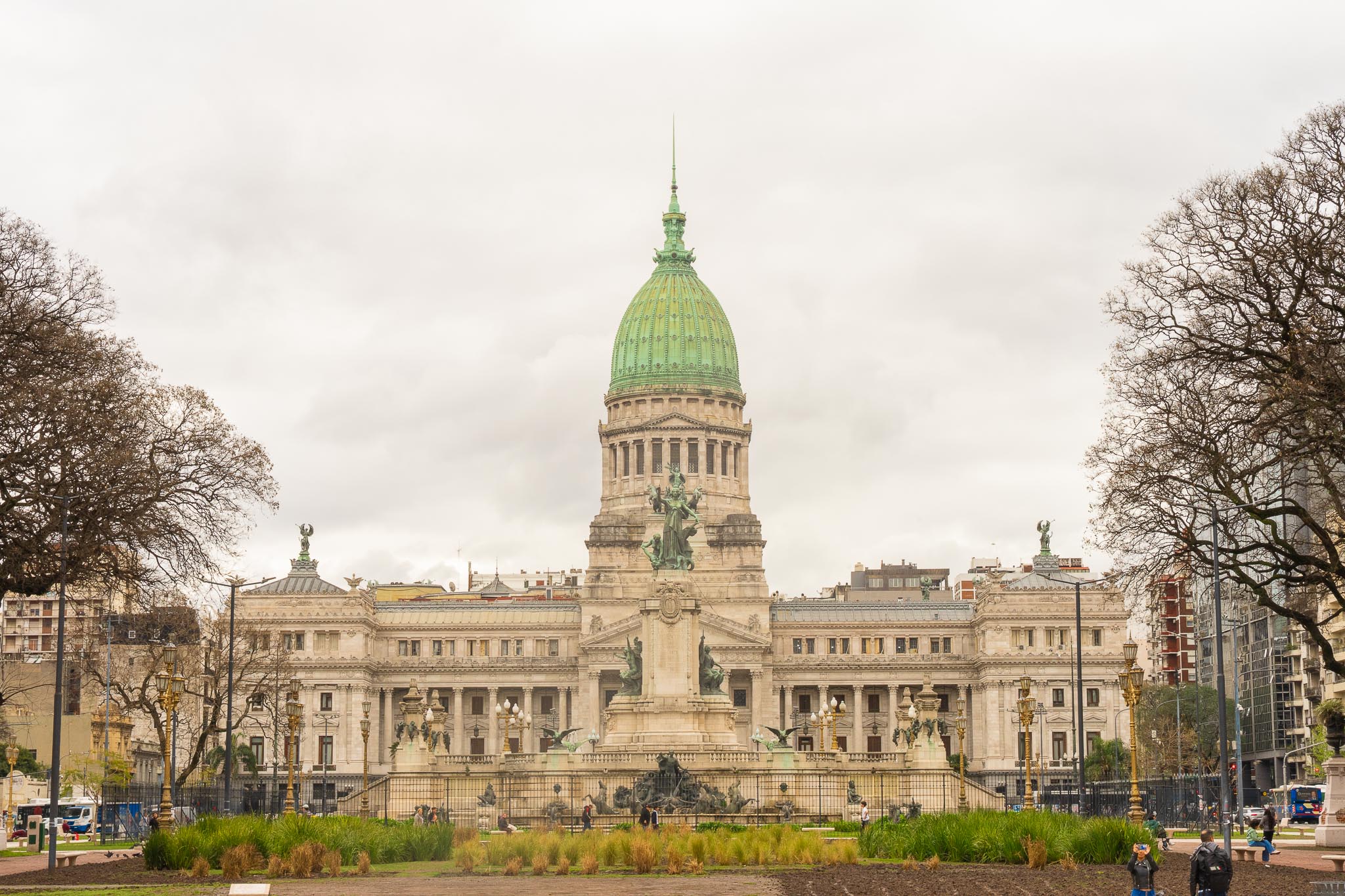
The walk passes buildings that belong to that change in scale. Palacio Barolo, with its architecture inspired by Dante’s Divine Comedy, rises above the avenue as a private monument to a more theatrical Buenos Aires. Farther west, Plaza del Congreso opens around the National Congress building, whose dome and academic architecture announce the legislative power of the modern nation.
The National Congress was designed by Víctor Meano, begun in 1898, inaugurated in 1906 and completed after later work in 1946. Its position at the end of Avenida de Mayo makes the relationship clear: Plaza de Mayo is the square of executive power, colonial memory and public assembly; Congress is the building of the legislative state. Between them, the avenue is the argument.
This was the natural continuation of the traveller’s first afternoon. The route moved from the square and its surrounding institutions towards Congress before dinner at Parrilla Peña. The exact walking time is less important than the connection. Buenos Aires built a civic spine that can still be read on foot, with public space doing as much historical work as the buildings beside it.
How much time do you need?
Allow two to three hours for Plaza de Mayo and the immediate historic centre. That gives time to stand in the square, read the Cathedral, Cabildo and Casa Rosada together, and continue to Manzana de las Luces without reducing the visit to a photograph and a departure.
Allow half a day if adding Avenida de Mayo and Congress. More time is useful when the Cabildo museum, the Cathedral interior, Manzana de las Luces, Palacio Barolo or a guided visit is a priority. Check current access, opening days and booking arrangements close to travel rather than relying on an old timetable.
Can you visit Plaza de Mayo and Congress together?
Yes. Avenida de Mayo makes them one of the most natural civic pairings in Buenos Aires. Begin at Plaza de Mayo, where the Cathedral, Cabildo, Casa Rosada and Pirámide establish the oldest and most politically charged part of the city. Then move west along the avenue, pausing for Palacio Barolo or the cafés and historic façades that line the way, before finishing around Plaza del Congreso.
The pairing works best as a half-day or longer. It can be extended with Manzana de las Luces at the beginning or a cultural interior along Avenida de Mayo, but there is no need to keep adding stops once the relationship between the two squares is clear.
Is Plaza de Mayo worth visiting?
Yes. It is one of the essential first stops in Buenos Aires.
The reason is not simply the number of landmarks. Plaza de Mayo gives a first visit a way to understand the city: colonial government in the Cabildo, Catholic authority in the Cathedral, executive power in Casa Rosada, revolutionary memory in the pyramid and public protest in the open ground around it. The surrounding streets then carry that reading towards Manzana de las Luces, Avenida de Mayo and Congress.
The square also prepares the traveller for the rest of Buenos Aires. Recoleta adds museums and monumental north; San Telmo shifts towards markets and older streets; Puerto Madero rewrites the waterfront; La Boca brings port history and football; Palermo opens into parks and a broader northern city. Plaza de Mayo is the first civic sentence, not the whole book.
Buenos Aires introduced itself through public space, and Plaza de Mayo remains the clearest place to see why. The traveller arrived through a city of later neighbourhoods, but the first afternoon began with the square that held the country’s older arguments: the Cabildo and the Cathedral, the Casa Rosada and the pyramid, the avenue to Congress and the public that keeps returning.
The square does not explain everything. It gives the city a centre from which everything else can be read.
But the road is ever onward.